


When property managers wait until the end of the month to tackle their accounting processes, everything piles up, questions come in late, issues surface after they’ve already become expensive, and the first week of the month turns into a pressure cooker.
That’s why more operators are switching to a continuous close.
This article breaks down what it is, why it works, and how to implement it with lightweight habits your team can actually maintain.
Why month-end feels so painful in STR accounting
Closing the books at the end of the month is common practice for most businesses, so it's understandable why this is the go-to approach. However, running a short-term rental management business is very different from running a bakery or a consulting firm. In a short-term rental (STR) business, you’re handling high volumes of transactions across multiple channels, reconciling cash for dozens of guests, vendors, and owners, splitting funds based on different commission rates, collecting a significant amount of cash in the form of advance deposits, and generating dozens (or hundreds) of owner statements.
So, waiting until month-end to look at the books often results in:
- Revenue issues discovered weeks after the stay occurred
- Unapplied receipts piling up (Stripe/Airbnb deposits you can’t immediately identify)
- Guest balances aren’t reviewed until it’s time to send owner statements
- Billable expenses arriving last-minute from operations, cleaners, or vendors
- Everyone scrambling for answers right when owners want their statements
All of this contributes to more stress, more backtracking, and slower reporting each month, and there's almost zero margin for error.
Rather than waiting to resolve all these issues at once, there's another option.
What is a “continuous close”?
A continuous close is exactly what it sounds like:
A set of daily or weekly accounting touchpoints that keep your books “close-ready” all month long, so month-end becomes a tidy-up, not a fire drill.
By performing accounting tasks on a more regular cadence, you can:
- Identify issues closer to when they happen (saving time spent retracing your steps)
- Create more “margin” in your process
- Reduce the end-of-month pile-up
- Get owner reporting out faster
- Spend less time reacting and more time operating
It’s not about doing more accounting.
It’s about doing the right small pieces consistently, so you stop paying the “panic tax” every month.
The mindset shift: Atomic Habits for accounting
The most common objection to continuous close is: “We don’t have time for that.”
But the truth is the opposite.
If you do a little every day—even just 15 to 30 minutes—you will more likely save time overall, because you’re not letting problems snowball.
If you've ever read Atomic Habits by James Clear (and you should), this is similar to the idea of getting “1% better every day.”
Small, consistent habits beat heroic month-end efforts every time.
The Continuous Close Checklist (what to do during the month)
Here are the key areas to build into a weekly rhythm. Remember, you don’t need to do all of these daily, but you should try to do a little bit throughout the month, so there's fewer surprises waiting for you at month-end.
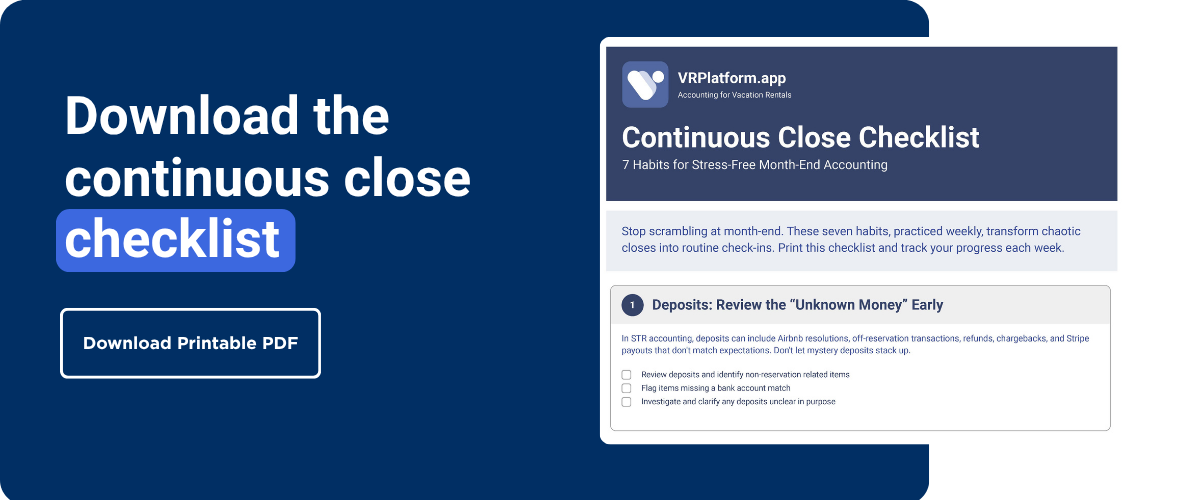
1) Deposits: review the “unknown money” early
In STR accounting, deposits can include:
- Airbnb resolutions
- Off-reservation transactions
- Refunds
- Chargebacks
- Stripe payouts that don’t match what you expected
The goal is simple: don’t let mystery deposits stack up.
Weekly habit: review deposits and identify anything that is:
- Non-reservation related
- Missing a bank account match
- Unclear in purpose
2) Bank reconciliation: match as you go
Month-end bank reconciliation works… until it doesn’t.
When you wait, you lose context:
- “Why is this charge here?”
- “Was this paid from the right account?”
- “Is this a duplicate?”
The earlier you reconcile, the easier it is to recognize what you’re looking at.
Daily/weekly habit:
- Accept auto-matches (provided for you in VRTrust)
- Investigate unmatched items
- Ensure reconciliation stays clean (and try to keep unreconciled transactions down to zero)
3) Guest balances + A/R: keep departed stays at zero
Reviewing guest balances and making necessary adjustments is one of property managers' biggest roadblocks to closing and reporting.
A strong rule of thumb:
For departed reservations, guest balance (A/R) should be zero, or you should know exactly why it isn’t.
Common “why it isn’t” reasons:
- A canceled reservation with funds that haven’t been allocated/refunded
- Funds still “in transit” from Stripe/Airbnb
- A legitimate unpaid balance (rare, but critical to catch)
Weekly habit:
- Review guest balances report
- Focus on departed stays
- Clear exceptions while context is still fresh
4) Cancellations: decide where the money goes
Cancellations create a unique accounting decision:
- Refund to guest?
- Keep as cancellation revenue?
- Allocate to owner?
If you don’t review cancellation activity, those balances linger and block clean statements.
Weekly habit: review cancellations, allocate the funds appropriately, and move on.
5) Unapplied receipts: clean them up before they snowball
Unapplied receipts are money you’ve received but haven’t linked to the right reservation.
That’s a continuous close killer because it creates uncertainty in both A/R and reporting.
Weekly habit: review unapplied receipts and assign them while you still remember what they are.
6) Billable expenses: the process is more important than the tool
Billable expenses often depend on other people:
- Field ops
- Maintenance
- Cleaners
- Guest services
So it's critical to have a repeatable process for capturing billable expenses when they are incurred.
If billable expenses show up one day before owner payouts, it's a recipe for last-minute scrambles.
Weekly habit: establish a schedule and assign responsibilities for expense capture and review processes
7) Preliminary owner statement review (before close week)
An underrated, but powerful step: review owner statements before the end of the month.
Even a lightweight “sanity check” helps you catch:
- Commission inconsistencies
- Strange net revenue outcomes
- Missing expenses
- Misallocations
Make it a habit to do a preliminary review the week before close.
Assign team responsibilities (because continuous close is not a solo sport)
A continuous close breaks down when expectations aren't clear. Humans are creatures of habit, so if left up to chance, it's most likely that your team will default to doing everything at month-end.
Changing that habit might take a little push, which can be as simple as setting task reminders throughout the month to help bring focus back to the checklist.
You should assign responsibilities for each step:
- Who reviews bank reconciliation?
- Who investigates unknown deposits?
- Who owns guest balances/A/R follow-ups?
- Who ensures billable expenses are submitted on time?
- Who does the pre-close owner statement review, and how do issues get flagged and addressed?
If you work with an outsourced accountant
You might be wondering, "I have an accountant who manages our books - does this still apply to me?" And the answer is: Yes.
A continuous close is beneficial for external accountants for the same reasons that it's beneficial to in-house accounting teams: it leads to issues getting resolved earlier in the month and reduces the pile-up of month-end accounting tasks.
Start by asking your accountant:
- What they can do to support a continuous close
- If they can send questions on uncategorized/unknown items on a weekly or bimonthly basis
- If you can preview statements earlier (with the understanding that they are not finalized)
What to expect from a continuous close
When you adopt a continuous close, month-end changes dramatically:
- Fewer surprises
- Less rework
- Fewer owner questions (because statements are cleaner)
- Faster reporting (days, not weeks)
- Less stress on the team
- More confidence in the numbers throughout the month
And most importantly: you’re no longer making decisions on outdated financials.
How to start (without overwhelming your team)
If you only do one thing this week, do this:
Start with a 10-minute daily habit
Pick one:
- Reconcile as many bank transactions as possible
- Review new deposits for “unknown money”
- Check departed guest balances for exceptions
Do it daily for a week.
Then layer in a weekly checklist.
That’s the continuous close mindset: small steps, repeated consistently, that remove month-end chaos.
Closing thought
STR accounting is hard because money moves fast, from too many places, with too many edge cases. Trying to run daily or weekly accounting checkpoints with disconnected tools or manual spreadsheets is what turns “continuous close” into more work instead of less.
That’s where VRTrust comes in.
VRTrust is built specifically for trust accounting in short-term rentals, with the automation needed to support continuous close workflows. Instead of waiting until month-end to reconcile everything at once, teams can:
- Automatically sync data from Airbnb, Stripe, booking channels, property management software, and other key fintech apps
- Use bank feeds and auto-matching to simplify reconciliations
- Flag unapplied receipts, unknown deposits, and guest balance issues early
- Review up-to-date trust balances, guest balances, and owner statements
- Lock periods and prevent accidental changes once books are closed
Because data is posted and updated in real time, teams can review, investigate, and correct issues closer to when they happen, which is the foundation of a continuous close.
Automation doesn’t replace good accounting habits, it reinforces them.
When systems are purpose-built for trust accounting and STR workflows, continuous close stops being an aspirational idea and becomes a repeatable, low-stress process your team can actually maintain month after month.
Ready to see how easy closing the books can be with VRTrust? Start a free trial today!
