


Managing vacation rental finances is a bit like juggling flaming torches while riding a unicycle: you're tracking guest payments from Airbnb, Vrbo, and direct bookings, splitting revenue with property owners, paying cleaners and maintenance crews, and making sure every dollar lands in the right place.
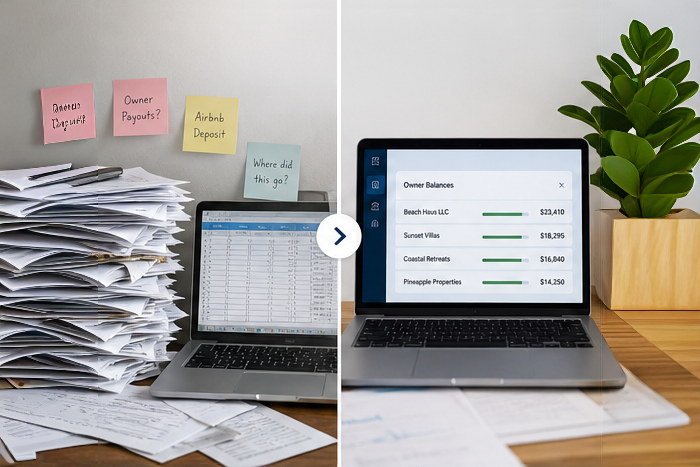
A spreadsheet might hold up when you have three or four properties. But once you get into the double digits, things start to break down quickly. Manual work piles up, mistakes become easier to make, and it gets harder to answer basic questions about where you stand financially.
Choosing the right accounting software is one of the highest-impact decisions you can make as you grow. The wrong setup doesn’t just slow you down—it can lead to missed revenue, messy reporting, and hours of extra work every month.
3 Types of Accounting Software
Not all accounting tools are built for the same job. Understanding the three main categories will save you from forcing a square peg into a round hole.
General Accounting Software
QuickBooks Online, Xero, and Sage Intacct are the systems most people think of in this category. These platforms handle invoicing, expense tracking, bank feeds, and standard financial reports. They work well for businesses with straightforward revenue streams: a consulting firm, a retail shop, a freelancer.
The problem for vacation rental managers is that these tools have no real understanding of how short-term rentals work. They don’t handle owner splits well, and they don’t track activity at the reservation level.
When Airbnb sends one deposit covering multiple reservations across different properties, QuickBooks just sees a single transaction. You’re left breaking it apart manually—figuring out what belongs to each property, calculating fees, and tracking what’s owed to each owner.
At five properties, this is annoying.
At ten or more, it starts taking real time every month.
At scale, it becomes one of the biggest bottlenecks in your business.
(See the top accounting software alternatives to QuickBooks→)
PMS Accounting Tools
Some property management systems like Guesty, Streamline, and Hospitable include some accounting features. You'll typically get reservation-level revenue tracking, basic owner statements, and maybe some expense categorization. These tools are convenient because they sit right next to your booking data.
But PMS accounting modules tend to be shallow. They rarely support true double-entry bookkeeping, three-way reconciliation, or detailed general ledger management. Think of them as financial dashboards rather than accounting systems. They'll tell you what happened, but they won't give you much flexibility or detail when it comes to deeper financial workflows.
Purpose-Built STR Accounting Platforms
Purpose-built short-term rental accounting platforms are designed specifically for how this industry operates.
At their foundation, they understand that:
- A single payout can include multiple reservations
- You need to track owner funds separately from operating funds
- Management fees and expenses need to be calculated automatically
These platforms typically connect directly to your PMS and payment systems, pulling in reservation and payout data so you don’t have to enter it manually.
The best ones also support reconciliation workflows that help you confirm everything lines up: your books, your bank account, and what you owe each owner. It’s not just about staying organized—it’s about having confidence in your numbers.
Critical Features to Evaluate Before You Buy
Software demos look great. Marketing pages promise everything. Here's what to actually test before committing.
Trust Accounting (Clearly Tracking Owner Funds)
If you’re managing properties on behalf of other owners, keeping their money clearly separated from your own is a best practice and something that becomes more important as you grow.
Your software should:
- Track owner funds separately from operating funds
- Help you reconcile balances regularly
- Make it easy to see what’s owed to each owner at any time
This isn’t just about process—it’s about clarity. When everything ties out, you can answer questions quickly and avoid small discrepancies turning into bigger issues.
(Learn more about trust accounting for vacation rentals→)
Bank and Payout Reconciliation
OTAs like Airbnb and VRBO don't pay you per reservation. They batch multiple payouts into a single deposit, often netting out their commission before the money hits your bank. Your accounting software needs to unbundle these batch deposits, matching each component back to the correct reservation and property. Without this, reconciliation becomes guesswork.
(Learn more about reconciliation for vacation rentals→)
Owner Balance Tracking
Every reservation generates revenue that gets split between you and the property owner. Expenses like cleaning fees, maintenance, and supplies reduce the owner's balance. Your software should maintain a running ledger for each owner, showing exactly what's owed at any given moment. Guest security deposits should appear as liabilities, and unearned revenue from future bookings should be tracked separately from earned income.
Owner Statements
Owners want to see where their money went. A good platform generates detailed monthly statements showing gross revenue, itemized expenses, management fees, and net payouts. Bonus points if owners can access these through a branded portal rather than waiting for you to email a PDF.
(Learn more about vacation rental owner statements→)
Integrations
Your accounting software needs to talk to your PMS, your payment gateway (Stripe, for example), and ideally your bank. Manual CSV imports are a fallback, not a strategy. Look for direct API integrations with the platforms you already use.
Real-Time Reporting
Monthly reports are the baseline. What really makes a difference is being able to see where you stand right now:
- How much cash you have
- What you owe owners
- Which properties are performing best
- Where expenses are trending
If you’re waiting until month-end to get answers, you’re always a step behind.
(Learn more about the types of financial reports for short-term rental managers→)
Top-Rated Accounting Platforms for Vacation Rental Managers
The best accounting software for your vacation rental business depends heavily on your portfolio size and operational complexity. Here's how the market breaks down in 2026.
Best for Individual Hosts: QuickBooks or Xero + PMS
If you manage fewer than 10 properties and primarily own your inventory, a lightweight setup built around Xero or QuickBooks Online paired with a PMS is sufficient for most operators.
Best for:
- Self-managing hosts
- Simpler bookkeeping needs
- Teams without dedicated accounting workflows
The tradeoff is that as your portfolio grows, more work becomes manual:
- Splitting OTA payouts
- Tracking owner balances
- Creating owner statements
- Reconciling deposits
The key limitation is that as you grow, the amount of time you spend on manual workarounds increases. You'll have to create custom categories for each property, manually split OTA deposits, and build your own owner statements outside of the system. For hosts who own all their properties outright (no third-party owners), this overhead is manageable.
When you start managing more properties for other owners, you'll need trust accounting capabilities these tools simply don't have.
Best for Property Managers Scaling Past 10-20 Properties: VRTrust
Once you pass 10–20 properties, accounting workflows usually become much harder to manage manually.
This is where purpose-built accounting systems like VRTrust start to stand out.
Best for:
- Dedicated STR accounting
- Property managers handling owner funds
- Teams struggling with reconciliation
- Automating owner statements
- Operators replacing spreadsheets and manual workflows
Because the platform is designed specifically for short-term rentals, it supports:
- Reservation-level accounting
- Automated reconciliation
- Continuous close workflows
- Owner balance tracking
- PMS integrations
- Full general ledger functionality
For a more detailed breakdown of how different platforms compare, see our Vacation Rental Accounting Software Comparison→
Best for PMS-Centric Operations: Guesty & Hospitable
Some property managers prefer to keep as much as possible inside their PMS.
Platforms like Guesty and Hospitable include accounting features alongside operations workflows.
Best for:
- Teams prioritizing operational simplicity
- Basic reporting needs
- Smaller portfolios
The limitation is that accounting tends to be secondary to operations, so deeper financial workflows often still require additional tools.
Best for Teams Embedded in QuickBooks: Tallybreeze (formerly bnbtally)
Some operators want to keep QuickBooks Online as their core accounting system while layering on short-term rental workflows.
Tools like Tallybreeze (formerly bnbtally) are often used for:
- Owner reporting
- Reservation syncing
- Structuring vacation rental data inside QuickBooks
Best for:
- Teams heavily invested in QuickBooks
- Operators not ready to move away from their existing accounting stack
The tradeoff is that you’re still maintaining multiple systems and syncing data between them.
Best for Multi-Entity Portfolios: Sage Intacct + VRTrust
As vacation rental companies grow across multiple entities, brands, or regions, accounting becomes significantly more complex. At this stage, many operators need more than basic bookkeeping—they need stronger financial controls, consolidated reporting, and workflows that can scale across a larger organization.
This is where enterprise accounting systems like Sage Intacct often come into the picture.
Sage Intacct is powerful for:
- Multi-entity financial management
- Consolidated reporting
- Advanced accounting controls
- Corporate-level financial reporting
But on its own, it still isn’t built specifically for short-term rental operations. It doesn’t naturally understand reservation-level accounting, OTA payout reconciliation, owner balances, or the day-to-day workflows property managers deal with.
That’s why many larger operators pair Sage Intacct with a purpose-built vacation rental accounting layer like VRTrust.
In this setup:
- VRTrust handles the trust and operational accounting workflows specific to the short-term rental entities
- Sage Intacct serves as the broader financial reporting and ERP system for the entire organization
This gives teams the best of both worlds:
- Reservation-level financial visibility
- Automated reconciliation workflows
- Faster owner statements
- Cleaner financial data flowing into the ERP
Learn how Brightwild uses VRTrust with Sage Intacct to speed up reconciliations, improve financial visibility, and deliver owner statements in record time: Read the Case Study→
For larger operators, this kind of layered approach often scales better than trying to force a traditional ERP to handle highly specialized short-term rental accounting workflows on its own.
Tax Compliance Tools for Lodging and Occupancy Taxes
Lodging taxes can be a significant headache, especially for multi-state portfolios. Rates vary by city, county, and state. Some OTAs collect and remit taxes on your behalf in certain jurisdictions but not others. Direct bookings almost always leave tax collection and remittance entirely in your hands.
Your accounting software should help you track these tax obligations at the reservation level and generate reports that make filing straightforward.
Additionally, platforms like Avalara MyLodgeTax will automatically update taxes by jurisdiction and handle the remittance process for you.
At minimum, you need the ability to see exactly how much lodging tax you've collected, for which jurisdiction, and whether it's been remitted. Getting this wrong doesn't just cost money in penalties: it can trigger audits that consume weeks of your time.
Comparing Vacation Rental Accounting Software?
Every platform approaches accounting differently:
- Some focus on bookkeeping
- Some focus on operations
- Some focus on reconciliation
- Some are full accounting systems built specifically for short-term rentals
If you want a side-by-side breakdown of features, integrations, owner statement workflows, reconciliation capabilities, and reporting flexibility, check out our full comparison guide: Vacation Rental Accounting Software Comparison Guide →
Managing Cash Flow and Operational Expenses
Revenue tracking gets most of the attention, but expense management is where many vacation rental businesses leak money.
Tracking Maintenance, Cleaning, and Unit-Level Costs
Every property has its own cost profile. A beachfront condo might have $200 cleaning turns and quarterly HVAC service. A mountain cabin might need snow removal and septic pumping. Your accounting software should let you assign expenses to specific listings so you can calculate true unit-level profitability.
The workflow should look something like this:
- An expense is incurred (cleaning after a guest checkout, for example).
- The expense is recorded and assigned to the specific property.
- If the expense is an owner responsibility, it's deducted from the owner's balance.
- If it's a management company expense, it hits your operating ledger.
- The expense appears on the next owner statement with a clear description.
Recurring expenses like monthly landscaping or Wi-Fi subscriptions should be set up once and applied automatically. Manual entry of the same $89 internet bill every month for thirty properties is a waste of everyone's time.
(Learn more about tracking expenses and fees for short-term rental management companies → )
Optimizing Payout Schedules and Bank Reconciliations
Most managers pay owners monthly, but the timing matters. Paying owners before you've reconciled the bank is risky: you might send money you haven't actually received yet.
The recommended workflow is to reconcile your bank account first, verify that all OTA deposits have been matched to reservations, confirm that your trust account balance matches the sum of all owner balances, and only then process payouts.
For high-volume operations managing more than fifty properties, waiting until the end of the month to reconcile everything creates an unnecessary bottleneck.
This is where modern vacation rental accounting software makes a huge difference. Instead of waiting until the end of the month to manually piece everything together, purpose-built systems enable a continuous close: transactions are matched, balances are updated, and reconciliation happens continuously in the background as reservations, payouts, and expenses flow through the system.
(Learn more about a continuous close for short-term rental property managers →)
At minimum, reconcile monthly, and always reconcile immediately before running owner payouts.
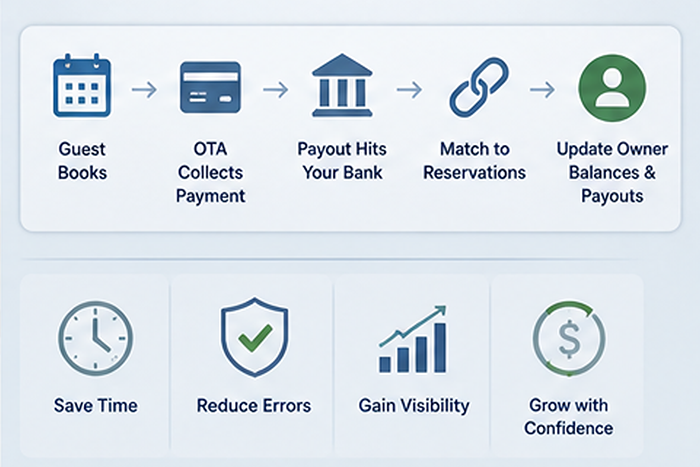
The chronological flow of funds matters: guest books a reservation, OTA collects payment, OTA deposits to your trust account, you match the deposit to reservations, deduct expenses and fees, update owner balances, furnish owner statements, payout owners, and transfer management company revenue to your operating account.

The Future of Accounting for Short-Term Rentals
The vacation rental accounting space is evolving quickly, driven by two major forces.
AI-Powered Tools
AI is starting to handle tasks that used to require a bookkeeper's judgment. Transaction categorization is the most obvious example: instead of manually tagging every bank transaction, AI models can learn your patterns and categorize with 95%+ accuracy after a few months of training data. Anomaly detection is another area where AI adds genuine value, flagging unusual charges, duplicate expenses, or missing deposits that a human might overlook during a busy month.
Some platforms are experimenting with AI-generated financial summaries that translate raw accounting data into plain-English insights: "Property X had 15% higher cleaning costs this quarter compared to last year" or "Your average days-to-payout increased from 12 to 18 days." These aren't replacing accountants, but they're making it easier for non-financial managers to spot trends and make decisions.
Impacts of Industry Regulation
Short-term rental regulation is tightening across North America and Europe. Cities are imposing registration requirements, occupancy limits, and stricter tax collection rules. Several states have expanded trust accounting requirements specifically for vacation rental managers, and enforcement is increasing.
This regulatory pressure is actually good news for managers who invest in proper accounting infrastructure. If your competitors are still running on spreadsheets, your ability to produce clean financial records becomes a competitive advantage. (Learn more about trust accounting as a competitive advantage →)
Expect more states to implement stricter reporting in the next two to three years, and expect OTAs to shift more tax remittance responsibility back to property managers as regulatory complexity grows.
Choosing Your Path Forward
The accounting setup that worked a year or two ago might not work as your business grows.
If you’re managing properties for other owners and scaling past ten or twenty units, manual processes and spreadsheets start to slow you down. Reconciliation takes longer, reporting gets harder, and it becomes difficult to stay fully confident in your numbers.
The right system should reduce manual work—automating things like transaction matching, owner statements, and expense tracking—so you can focus on running and growing your business.
Look for software that supports the full flow of your operations, from booking through payout, and helps you keep everything organized in one place.
Platforms like VRTrust are built specifically for this, combining accounting workflows, reporting, and integrations into a single system designed for short-term rental managers.
