



Compliance and Audit Reports Every Property Manager Should Run (Before It’s Too Late)
Trust accounting is only as good as your ability to prove it.
Property managers often think of compliance reports as something to generate when someone asks for them — a broker, an auditor, a state regulator, or even an owner. But by the time you're being asked for documentation, you're already in the danger zone.
The truth is: if you can't generate audit-ready reports on demand, your accounting system is broken. And broken accounting systems don’t just create risk — they create chaos.
Most operators don’t realize their reporting gaps until they're forced to reconcile under pressure. An owner dispute. A tax filing deadline. A licensing renewal. A new CPA onboarding. That's when everything breaks.
Then they start backtracking through payouts, spreadsheets, bank statements, and reservation records trying to reconstruct what happened.
The goal of compliance reporting is to prevent that moment.
Even if you're not legally required to follow strict trust accounting rules, strong compliance reporting is the foundation of good property manager accounting. It’s what keeps your books clean, protects your owners, and makes your business scalable.
Why Most STR Operators Fail Compliance Reporting
Most vacation rental accounting systems aren't designed for trust accounting. They're designed for general business bookkeeping.
That means they can track your expenses and income, but they can't handle the core accounting problem in property management:
You're managing money that isn't yours.
You hold guest payments. You hold owner revenue. You owe owners distributions. You owe tax agencies collected taxes. You owe vendors bills. And all of it moves through your bank accounts in a way that must be tracked and reconciled.
If your software doesn't separate owner funds from management income, doesn't track each stakeholder's balance over time, and can't generate reports proving where every dollar is, compliance becomes impossible.
The result: most operators rely on manual spreadsheets and after-the-fact reconciliations to piece together reporting.
They might “get by” for a while. But eventually, the cracks show.
The most common signs:
- Owner balances don't match bank accounts
- Guest deposits are not tracked separately
- Taxes are not clearly categorized
- Adjustments are made with no audit trail
- Reports can’t be generated without manual work
If any of these sound familiar, you need compliance reporting — not later, now.
The 5 Compliance and Audit Reports You Should Be Running
Most operators don't start building compliance workflows until something forces them to. The best operators build them early, when systems are simple and the stakes are lower.
Here's the truth: if you're waiting until you have 100 properties, you're already in trouble. Compliance gets harder as you grow, not easier. By then, it's too late to build good habits. You're in reconstruction mode, piecing together records that should have been maintained all along.
This guide covers the five compliance and audit-ready reports every vacation rental manager should generate regularly (not just on demand).
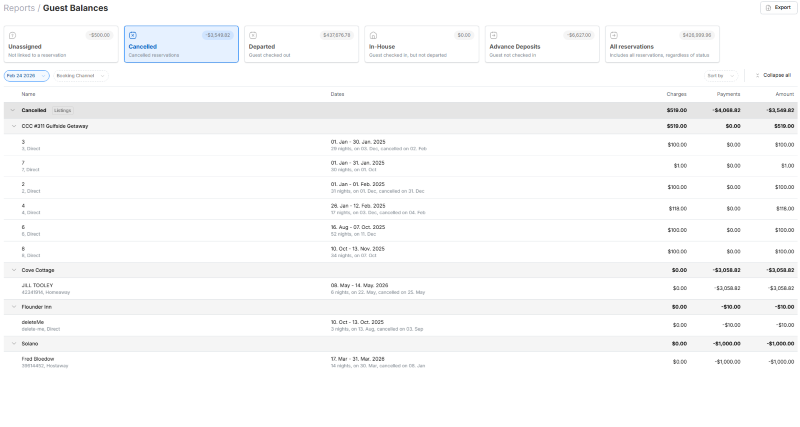
1. Guest Balances Report (or Trust Compliance Report)
A trust compliance report confirms that your trust account is being managed in accordance with your fiduciary obligations. It's the formal record that answers the question: "Are owner funds safe and accounted for?"
What it contains:
- Trust account opening and closing balances for the period
- Total funds held on behalf of owners (sum of all owner ledger balances)
- Total guest deposits held (security deposits, advance payments not yet earned)
- Total tax liabilities held (collected but not yet remitted)
- Confirmation that the sum of the above equals the trust account bank balance
How often to run it: Monthly, at minimum. Some states require monthly trust compliance reports as a condition of maintaining a real estate broker license.
What to do when it doesn't balance: Some discrepancies can be due to a rounding error, others can indicate a much more serious issue. Either way, it's important to look into any imbalance, identify the source transaction, correct it, and document the resolution. The last thing you want to do is carry unresolved discrepancies forward to the next period, where the issue can get buried or snowball.
Retention: Keep trust compliance reports for at least 3 years.
2. Trust Account Statements
A trust account statement is the per-period ledger for your trust account. This is the same type of document a bank produces, but should be generated by your accounting system at the transaction level.
What it contains:
- Every debit and credit posted to the trust account during the period
- Opening balance, all transactions in date order, closing balance
- Running balance after each transaction
Why this matters: The trust account statement is how you prove, transaction by transaction, where every dollar went. In an audit, regulators will trace specific owner payouts or guest refunds back to this record. They will be looking to see if the statement is incomplete, has gaps, or shows unexplained adjustments.
Common issue to watch for: Transactions posted with generic descriptions like "owner payout" or "expense" with no property or reservation reference. Every trust account transaction should be traceable to a specific property, owner, reservation, or invoice.
3. Audit-Ready Reports
An audit-ready report package is the complete set of documents you would hand to an auditor or an assessor. Assembling this under pressure is stressful and time-consuming, so it's better to know with certainty where you can find this information (and that it will be accurate) when you need it.
A complete audit-ready package includes:
1. Trust reconciliation report for the period
2. Trust account statement (bank-level detail)
3. Three-way reconciliation worksheet (bank balance = book balance = sum of owner/guest ledgers)
4. Owner ledger balances as of the audit date
5. Sample owner statements (selected at random)
6. Sample reservation records tied to statement line items
7. Vendor invoices for expenses appearing on owner statements
8. Copies of management agreements for sampled owners
When to assemble it: You shouldn't need to assemble this under audit pressure — it should be current at all times. Build a process that ensures each component of your audit-ready package is available and up to date.
What questions it answers:
- "What was the trust account balance as of [date]?"
- "How did the owner ledger for [owner name] change between [date] and today?"
- "Does this owner payout trace to the bank statement?"
- "What part of the management agreement authorizes this fee?"
If you can answer all four in under ten minutes, you're audit-ready.
4. Reconciliation Reports
A reconciliation report confirms that what your accounting system says happened matches what actually happened in your bank account.
The three-way reconciliation:
There are three numbers that must agree:
1. Your bank statement balance (what the bank shows)
2. Your trust ledger balance (what your accounting system shows)
3. The sum of all individual owner and guest balances (what you owe to each stakeholder)
All three must be equal. If any two agree but the third doesn't, you have a classification error. If none agree, you have a more serious problem.
How to run reconciliations efficiently:
- Reconcile weekly during high-volume seasons, monthly at minimum
- Start with bank statement → match each transaction to a ledger entry
- Flag unmatched items and resolve
- Document the reconciliation with a date stamp
Common reconciliation errors and their sources:
5. 1099 Summaries
A 1099 summary is the year-end report that tells you and your accountant how much each owner and vendor was paid during the calendar year.
For property owners: If an owner received more than $600 in gross rental income payments during the year, you are generally required to file a 1099-MISC (or the relevant form for your jurisdiction). The 1099 summary report should show each owner's name, SSN or EIN, total payments, and payment method.
For vendors: If you paid a vendor (contractor, handyman, cleaning company — not a corporation) more than $600 during the year, you may need to file a 1099-NEC. Your expense reports should allow you to filter by vendor and sum annual payments to identify who crosses the threshold.
Common mistakes:
- Issuing 1099s based on payments *made* rather than gross revenue
- Forgetting to collect W-9 forms from new vendors before they're paid (you cannot issue a 1099 without their taxpayer information)
- Including guest refunds on owner 1099s
Timing: 1099 forms must be issued to recipients by January 31 and filed with the IRS by January 31 (for 1099-NEC) or February 28/March 31 (for 1099-MISC, paper/electronic respectively). Run your 1099 summary in December to identify any gaps before the deadline.
How to Prepare 1099 Forms for Property Managers: A Complete Guide →
Building a Compliance Calendar
The best way to reduce stress and achieve financial peace of mind is to make compliance reports part of your regular accounting rhythm, not a one-time response to external pressure.
Monthly:
- Trust compliance report
- Trust account statement
- Three-way reconciliation
- Reconciliation audit (review the past three months for any unresolved items)
- Update components of the audit-ready package
Quarterly:
- Vendor payment totals (to track who is approaching the 1099 threshold)
Annually:
- 1099 summary (run in December, issue in January)
- Records retention review (archive older records; verify digital backups)
See how VRTrust handles compliance reporting →

