


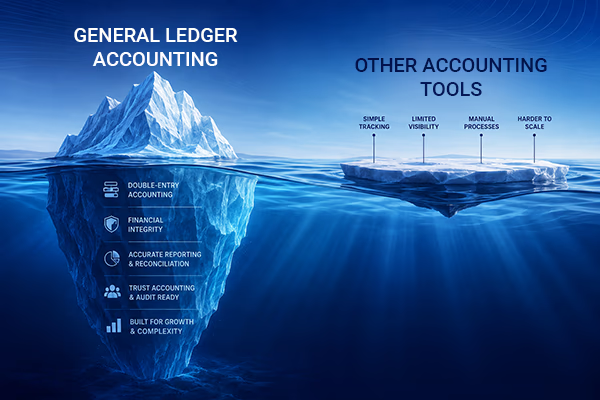
How General Ledger Accounting Systems Differ From Typical Short-Term Rental Accounting Tools
If you manage vacation rentals, there are essentially two kinds of accounting software you can choose for your business.
First, there's general accounting platforms like QuickBooks or Xero that have true double-entry general ledgers, but have no idea what a reservation, an owner disbursement, or a trust account is. On the other hand, you have short-term rental accounting tools built specifically for the industry, but many of them were designed first as reservation and owner-payout trackers, with accounting features layered on afterward.
To understand the difference, it's important to know what a general ledger actually is, and what you give up when it's missing from your software.
What is a general ledger?
A general ledger (GL) is the backbone of formal accounting. It's built on a few principles that have stayed essentially unchanged for centuries, because they work:
- Double-entry accounting. Every transaction hits at least two accounts — a debit and a credit — so the books are always structurally balanced. This is what makes your financial statements trustworthy and auditable.
- A flexible chart of accounts. A real GL lets you organize transactions into the categories your business actually needs — assets, liabilities, equity, income, expenses — and customize that structure as you grow.
- A permanent audit trail. Every entry is traceable: from when it was created to what it affected. That matters the moment you're asked to explain a number to an owner, an accountant, or an auditor.
- Multi-dimension reporting. A mature GL can slice the same data multiple ways — by property, by owner, by vendor, by department — without re-entering anything.
- Real financial statements. A Balance Sheet, P&L, Trial Balance, and General Ledger report that are all generated from the same underlying data, so they always agree with each other.
This is the standard that governs how every properly run business tracks money, and it's the standard most CPAs and banks expect you to operate under.
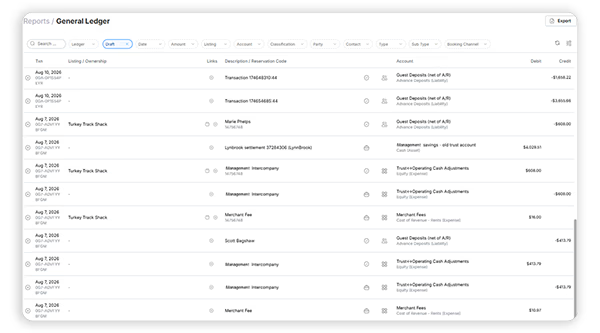
Where typical short-term rental accounting tools falls short
Plenty of software built for vacation rental managers is genuinely good at the things it was designed for: tracking reservations, calculating owner payouts, generating statements, automating fees. But "good at trust accounting" and "built on a real general ledger" are not the same thing, and a lot of STR-specific tools were built as the former without the latter. (Explore the Best Accounting Software for Vacation Rental Managers)
The practical symptoms show up like this:
- Owner ledgers that aren't really a GL. Some tools track owner balances as running totals rather than as double-entry accounts, which means there's no true balance sheet or audit trail behind the numbers — just a log of debits and credits to one owner bucket.
- No support for your own company's books. If the software only understands trust balances, you're forced to use a separate system — QuickBooks, a spreadsheet, or both — to track your management company's payroll, vendor bills, or overhead.
- Reports that don't reconcile with each other. Without a unified GL, your Balance Sheet and P&L can be built from different underlying logic, so they don't always tie out the way you'd expect.
- Manual journal entries for anything unusual. Moving funds between accounts, correcting an error, recording a reimbursable expense — without real GL flexibility, these often require workarounds instead of a clean, auditable entry.
These issues don't always show up at the surface, but when you start to look deeper into your reconciliations, your reports, and your ability to answer questions about your company's cash flows, it becomes clear that the accounting rigor is thinner than it looks.
The trade-off for short-term rental managers
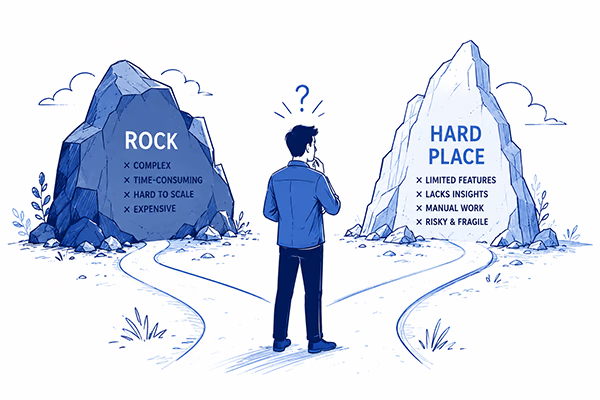
For years, vacation rental managers have had to pick one:
Option A: A real general ledger, with no industry fit. QuickBooks or Xero give you genuine double-entry accounting, but you'll spend real time building manual workarounds for trust accounting, owner statements, reservation-level detail, and fee automation — the exact things your business runs on every day.
Option B: Industry-specific software, with a thinner ledger underneath. Short-term rental accounting tools handle reservations and owner payouts well, but if they aren't built on a real GL, you inherit weaker audit trails, less reliable reporting, and no way to run your own company's books through the same system.
Managers have historically solved this by running both — a general accounting platform for the business, a trust-accounting point solution for owner funds — and reconciling between them manually or with DIY workarounds. That's the two-ledger problem, and it's the direct result of no single tool combining both halves well.
How VRTrust closes the accounting gap
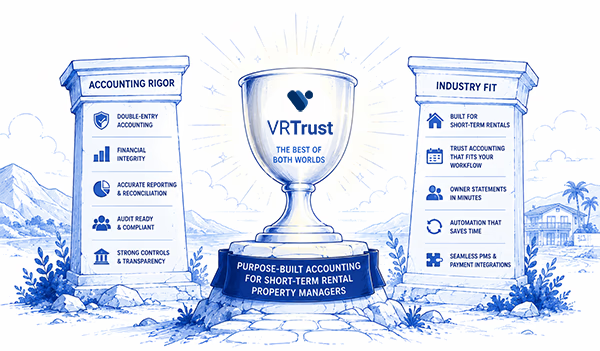
This is the gap VRTrust was built to close. It's a complete general ledger with double-entry accounting — a real chart of accounts, auditable journal entries, and multi-dimension tagging across listing, owner, guest, vendor, and line item — the same rigor a CPA would expect from any properly run set of books.
On top of that GL, VRTrust adds the industry-specific layer that generic platforms don't have: automated three-way reconciliation (bank balance, book balance, owner ledger), owner statements generated directly from the ledger rather than a separate report, and fee and commission automation tied to reservation-level activity.
And with Operations Accounting (OPEX), that same structure extends to your management company's own books — payroll, vendor bills, overhead — alongside the trust accounts you already run, in one connected workflow. Trust and operating bank accounts reconcile side-by-side, Due To / Due From entries post automatically when funds move between them, and your Balance Sheet, P&L, General Ledger, and Trial Balance can show trust-only, operating-only, or combined views, all built from the same source of truth.
The result isn't a trust accounting tool with a ledger bolted on, and it isn't a general accounting platform with rental features bolted on. It's an all-in-one accounting system, built to the standard your accountant expects, designed around the way vacation rental management businesses actually work.
The bottom line
A general ledger isn't just accounting jargon, it's what makes financial statements trustworthy, auditable, and reconcilable with each other. Software that skips it in favor of industry-specific convenience is trading rigor for fit. VRTrust was built on the belief that vacation rental managers shouldn't have to choose.
