



How Vacation Rental Accounting Is Evolving in the AI Era
For most property management companies, "using AI" still means one thing: opening a chat window and asking it a question. That's useful, but it doesn't even scratch the surface of its full potential.
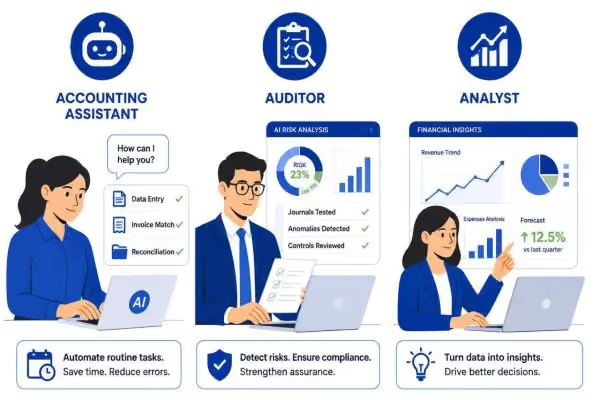
In this article, we'll explain how short-term rental accounting teams are using AI in everyday workflows, not just as a search tool, but as something closer to a coworker: an assistant that handles setup, an auditor that catches exceptions before they reach an owner, and an analyst that builds the report you don't have time to build yourself.
From searching to delegating
Before AI, accounting work in a property management company followed a familiar pattern: you hoped you were working on the right thing, you clicked through screens to find answers, you exported data before you could analyze it, and you did every task yourself, one click at a time.
AI changes that pattern, not just by answering questions faster, but by eliminating the steps entirely.
Instead of hoping nothing important slips through the cracks, you get an executive summary of what actually needs your attention today. Instead of navigating software to find an answer, you ask in plain English and get one instantly. Instead of exporting data and building a report before you can look at it, AI surfaces the insight directly. And instead of doing every task yourself, you delegate the work and review the output, the same way you'd hand a task to a member of your staff.
This is the most important shift, and it's happening across every vertical. The companies getting the most value out of AI right now aren't the ones writing clever prompts. They're the ones treating AI like a teammate: training it on their business, giving it a shared knowledge base of SOPs, correcting its output, assigning it recurring responsibilities, and expanding what it's trusted to do over time.
The piece that makes the biggest difference: MCP
None of that delegation is possible without a way for AI to actually reach into your accounting data, not just read about it secondhand.
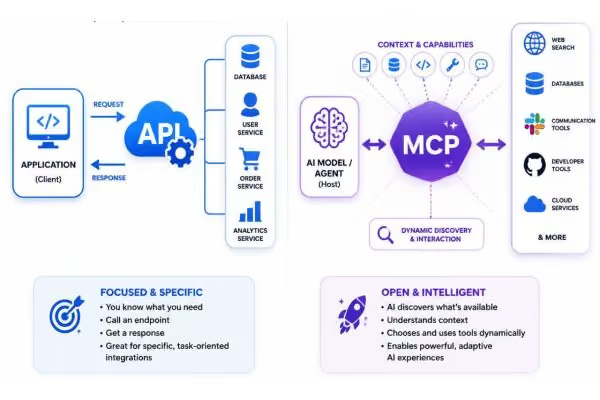
That's what MCP, the Model Context Protocol, does. It's a connective layer that lets an AI assistant speak to and interact with your accounting platform directly, with both read and write access, rather than being limited to whatever you copy and paste into a chat window.
Here's how this differs from a traditional API:
- A traditional API retrieves data. It requires a developer to build custom integration logic, and once built, it can only do exactly what that logic was written to do.
- An MCP explains your system to the AI model itself. The AI knows what tools and actions are available to it without anyone hand-coding the logic, and because of that, it can reason through a workflow, not just fetch data, but actually work out "what should I do next?" and take the action itself.
Practically, that means an MCP-connected AI agent can:
- Work across your entire portfolio at once, because your accounts, listings, and reports stay connected as a single source it can query, rather than needing separate exports per property.
- Give you real-time answers instead of a report generated last week, because it's querying live data.
- Complete accounting tasks hands-free, meaning you don't have to log into the app at all for certain work to get done.
- Do all of this securely, because the connection is controlled and permissioned, not a manual data export sitting in someone's downloads folder.
(Keep in mind, this means that your data, terminology, and documentation need to be structured so AI models can accurately understand your accounting workflows in the first place. An AI can only reason through a task as well as the underlying system lets it.)
So, what are the jobs that AI can do well when it comes to short-term rental accounting?
AI as an accounting assistant
Doing the repetitive setup and monitoring work that used to require hundreds of clicks and hours of manual oversight.
- Onboarding and setup. When a new listing comes in, you can teach AI your standard checklist, so it sets up the ownership record, configures recurring fees and commissions, and follows your internal onboarding SOP end to end.
- Continuous monitoring. New PMS line items show up constantly as channels and integrations change. Historically, someone has to manually classify each new line type: is it rent, a discount, a tax, a fee? AI can detect new, unmapped PMS line types, suggest a GL mapping based on how similar transactions have been coded before, and flag anything unmapped before it turns into a reconciliation problem down the line, rather than after.
- Daily operations. AI can alert you when a new deposit comes in unassigned, apply your existing bank rule logic to categorize incoming transactions, and escalate the transactions that you want a human to review, whether that's all of them, or only the outliers.
AI as an auditor
Where the assistant role handles setup and monitoring, the auditor role is about catching problems in existing data before they reach an owner.
- Reservation reviews. A common source of quiet errors: a reservation gets cancelled, but the balance never gets refunded or recognized as cancellation income. AI can investigate cancelled reservations with remaining balances, review departed guests who still show an outstanding balance, and explain in plain language why a given reservation still has one, whether that's an unrefunded deposit, an unrecognized cancellation fee, or something else. It can also be taught to handle the accounting logic that follows, such as splitting cancelled fees between what revenue belongs to the company and what belongs to the owner.
- Owner statement quality checks. Before an owner statement goes out, AI can verify that management fees and channel fees were actually deducted, confirm recurring fees weren't accidentally left off a listing, and identify statements where the commission calculation looks wrong. This could mean checking whether every non-Airbnb reservation had its expected processing fee, whether every Booking.com reservation had its channel fee, and whether merchant commissions matched the expected percentage across the portfolio, then flagging the exceptions and explaining the likely cause: a fee that was set up incorrectly, or one that was never applied to that particular listing.
- Transaction investigation. This is the guest balance work most accountants dread: reviewing uncleared transactions, explaining unusual postings or adjustments, and answering the accounting questions that come up along the way. Instead of opening reservations one at a time to ask "why does this guest have a balance," AI can review the guest balance report as a whole and come back with specific findings, for example, an additional deposit received for a pet fee or an extra night that needs a financial adjustment, and tell you exactly what to do about it.
AI as an analyst
Turning your accounting data into answers and reports that don't exist in any out-of-the-box system.
- Business analysis. Once AI has context on your accounting data, it can calculate your management take rate, measure revenue retained after taxes and pass-through expenses, and identify trends across owners, listings, or channels, the kind of analysis that used to mean exporting everything into a spreadsheet and building a pivot table from scratch.
- Custom reporting. Some reports simply don't exist as standard features in most platforms. Sales tax liability by jurisdiction is a good example: rather than build it by hand every filing period, you can upload a listing-to-jurisdiction mapping once and have AI generate a sales tax liability report, a listing-level tax summary, or a compliance report on an ongoing basis using your live financial data. One team went further and built a Claude skill that runs a full three-way reconciliation check for a trust county requirement, taking a process that used to take hours after each month's close down to a ten- to fifteen-minute review.
Scheduled intelligence
If you're thinking that manually prompting your AI agent to perform these functions still sounds like more work for your team, think again. Any task, process, or report can run on a schedule: a monthly sales tax report delivered automatically, an owner statement quality summary sent before statements go out, or an alert flagging unusual financial activity as soon as it appears, rather than at month-end when it's harder to trace.

Three takeaways for short-term rental managers
First, think of AI as a coworker, not a search engine, the biggest shift isn't getting faster answers, it's getting work actually completed, automated, and offloaded from your team.
Second, go beyond one-off prompts: train your AI on your processes, give it feedback the way you would an employee, and hand it recurring responsibilities rather than re-explaining the same task every time.
Third, context is the real competitive advantage. An AI that can only see what you paste into a chat window is fundamentally limited. An AI connected through MCP, one that understands your accounting system directly, is what makes accurate, reliable, and genuinely autonomous work possible.
If you need help getting started, we put together a free MCP prompt guide covering these workflows and more, built specifically for what's possible with an MCP-connected accounting platform.
